
Germany Life and Non-Life Insurance Market to Reach USD 350.68 Billion by 2031, Supported by Ageing Population, Digital Distribution and Unit-Linked Products, Says Mordor Intelligence
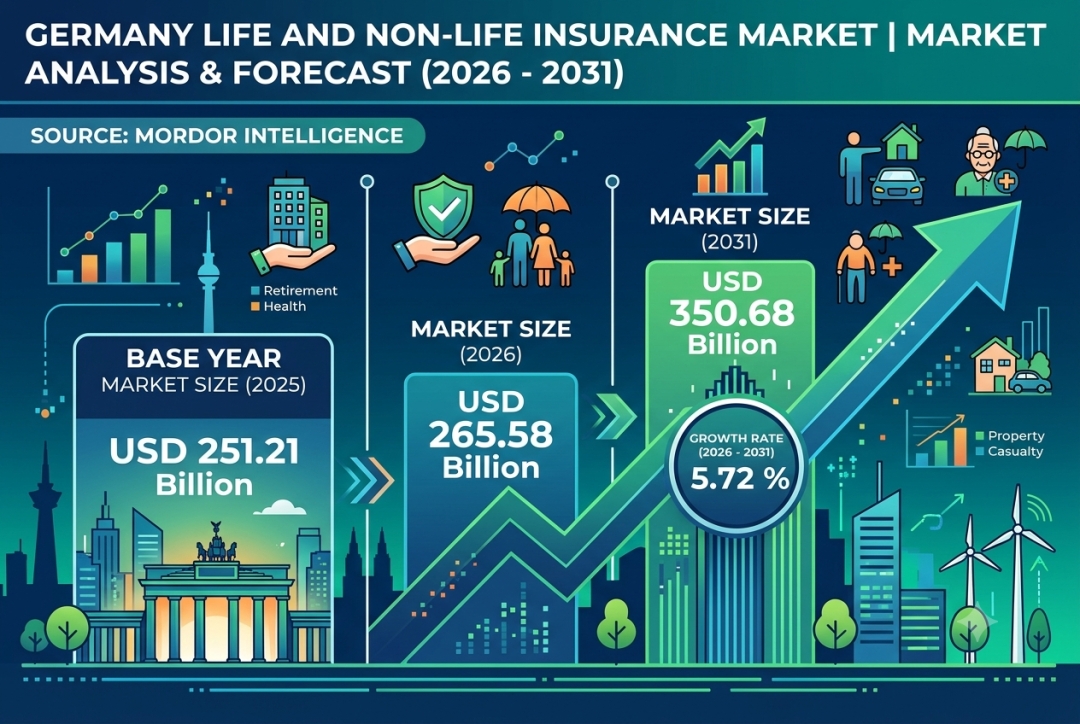
Hyderabad, India, November 13, 2026: According to Mordor Intelligence, the Germany Life and Non-Life Insurance Market Size is expected to increase from USD 251.21 billion in 2025 to USD 265.58 billion in 2026 and reach USD 350.68 billion by 2031, registering a CAGR of 5.72% over 2026-2031. Growth is supported by ageing demographics and retirement needs, stronger demand for risk-transfer products, increasing digital engagement, property and motor insurance demand linked to climate risks and repair costs, and regulatory changes under the revised Solvency II framework.
Germany Life and Non-Life Insurance Market Growth Drivers
Ageing population supports retirement and annuity demand
Germany’s ageing population is increasing the need for private retirement solutions and annuity products. Households are seeking insurance products that can provide more resilient retirement income as traditional guarantees become less suited to changing inflation and investment conditions. Insurers are responding with hybrid annuities that combine partial guarantees with diversified investment exposure, creating opportunities across life insurance products.
Digital adoption strengthens direct and online distribution
Digital engagement is changing how consumers compare, purchase, and manage insurance policies. Online aggregators, comparison portals, bancassurance platforms, and embedded-insurance services are gaining relevance, particularly for standardized products. Insurers are also using digital tools for underwriting, claims handling, quotation, and customer service, while partnerships with InsurTech companies are supporting faster product development and more streamlined customer journeys.
Natural catastrophe risks increase property insurance demand
Floods and other natural catastrophe events have increased awareness of protection gaps in Germany. This is supporting demand for extended building cover and other natural-hazard protection. Improved risk zoning and the use of parametric insurance solutions are also creating new ways to address catastrophe exposure, particularly in areas with higher flood risk.
Solvency II influences product and investment strategies
The revised Solvency II framework is influencing how insurers manage capital, sustainability requirements, and product design. Lower-capital products, including unit-linked policies, are gaining attention as insurers seek to manage guarantee-related pressure and improve capital efficiency. This is encouraging a gradual shift toward products where policyholders carry a greater share of investment risk.
Access This Report in Japanese: https://www.mordorintelligence.com/ja/industry-reports/life-non-life-insurance-market-in-germany?utm_source=abnewswire
Germany Life and Non-Life Insurance Market Segmentation
The Germany Life and Non-Life Insurance Market is segmented by insurance type, distribution channel, end user, provider type, premium type, and region.
By insurance type:
-
Life insurance: Includes term life, endowment and whole life, unit-linked or investment-linked products, annuity and pension products, and other life products.
-
Non-life insurance: Includes motor, property, general liability, supplementary health, accident and disability, marine, aviation and transport, and other non-life products.
Non-life insurance remains an important part of the market, supported by property, liability, and motor demand, while annuity and unit-linked products are gaining momentum within life insurance.
By distribution channel:
-
Agents and brokers
-
Bancassurance
-
Direct online
-
Aggregators and comparison portals
-
Affinity and partnerships
Agents and brokers remain important for complex pension and commercial products, while digital-only and aggregator channels are expanding as consumers increasingly compare policies online. Bancassurance and embedded insurance are also widening digital access to standardized insurance products.
By end user:
-
Individuals
-
Corporates and SMEs
-
Public institutions and non-profits
Individuals remain a major customer group, while SMEs are creating additional demand for cyber, professional indemnity, directors’ and officers’ liability, supply-chain, and climate-related coverage.
By provider type:
-
Private shareholder-owned insurers
-
Mutual and cooperative insurers
-
Foreign subsidiary insurers
The provider landscape includes large private groups, regional mutual insurers, cooperative organizations, foreign subsidiaries, and digital-focused providers. This diversity keeps competition active across personal and commercial insurance lines.
By premium type:
-
Single premium
-
Regular premium
Regular premiums remain widely used for life and long-term health contracts, while single-premium products serve customers seeking lump-sum retirement and investment solutions. Flexible contribution options are also being introduced to support changing customer needs.
By region:
-
North Germany
-
West Germany
-
South Germany
-
East Germany
West Germany benefits from dense population centers, financial hubs, and strong demand for retirement and commercial insurance. East Germany is the fastest-growing regional market, supported by rising vehicle ownership, mortgage activity, and service expansion. South Germany benefits from industrial exporters, automotive manufacturers, technology companies, and household wealth, while North Germany has strong demand for marine, cargo, logistics, and natural-hazard coverage.
Explore Our Full Library of Financial Services and Investment Research Reports: https://www.mordorintelligence.com/market-analysis/financial-services-and-investment-intelligence?utm_source=abnewswire
Germany Life and Non-Life Insurance Market Key Players
The competitive landscape includes established insurers, mutual groups, foreign subsidiaries, and providers with specialized capabilities across life, non-life, commercial, and specialty insurance. Major companies covered in the market include:
-
Allianz SE
-
Munich Re (ERGO Group)
-
Talanx AG (HDI)
-
R+V Versicherung AG
-
Generali Deutschland AG
-
AXA Konzern AG
-
Zurich Gruppe Deutschland
-
Debeka Gruppe
-
Signal Iduna Gruppe
-
DEVK Versicherungen
-
Gothaer Versicherung
-
HUK-Coburg Versicherungsgruppe
-
Württembergische Versicherung AG
-
LVM Versicherung
-
Barmenia Versicherungen
-
HanseMerkur Versicherungsgruppe
-
Provinzial Holding AG
-
Nürnberger Versicherung
-
Versicherungskammer Bayern
-
Alte Leipziger – Hallesche Konzern
-
Concordia Versicherung
-
VHV Holding AG
-
ARAG SE
Competition is supported by the presence of large national groups alongside regional mutuals and specialist providers. Insurers are strengthening digital capabilities, refining underwriting, and developing products for retirement, climate, cyber, and commercial risks.
Germany Life and Non-Life Insurance Market Forecast
The Germany Life and Non-Life Insurance Industry is expected to maintain steady growth as households, businesses, and public organizations continue to seek protection against financial, property, liability, climate, and retirement-related risks. Digital distribution will remain an important channel for standardized products, while agents and brokers will continue to support complex insurance needs.
The market outlook is also shaped by changing demographics, regulatory requirements, natural catastrophe exposure, and the shift toward capital-efficient life products. Demand from SMEs, continued digital adoption, and regional differences in insurance needs are expected to create opportunities for both established carriers and newer InsurTech providers.
For more insights on this market, please visit the Mordor Intelligence page: https://www.mordorintelligence.com/industry-reports/life-non-life-insurance-market-in-germany?utm_source=abnewswire
About Mordor Intelligence
Mordor Intelligence is a global market intelligence firm, founded in 2014, helping businesses make informed decisions through data-driven insights, industry expertise, and advanced analytics. With domain experts and on-ground specialists across countries and industries, the company delivers research across aerospace and defense, agriculture, automation, automotive, chemicals and materials, consumer goods and services, electronics, energy and power, financial services, food and beverages, healthcare, hospitality and tourism, information and communications technology, and logistics.
Its offerings include syndicated industry reports, custom research and advisory, and subscription platforms. Mordor Intelligence is ISO 9001:2015 and ISO/IEC 27001:2022 certified, a member of ESOMAR and the Market Research Society of India, and a Great Place to Work honoree.
For any inquiries or to access the full report, please contact:
https://www.mordorintelligence.com
Media Contact
Company Name: Mordor Intelligence
Contact Person: Jignesh Thakkar
Email: Send Email
Phone: +1 617-765-2493
Address:11th Floor, Rajapushpa Summit, Nanakramguda Rd, Financial District, Gachibowli [email protected]
City: Hyderabad
State: Telangana 500008
Country: India
Website: https://www.mordorintelligence.com/

