
Edible Insects for Animal Feed Market Size to Reach $5.60 Bn by 2031 as Demand for Sustainable Protein & Auto Insect Farming Gains Momentum – Mordor Intelligence
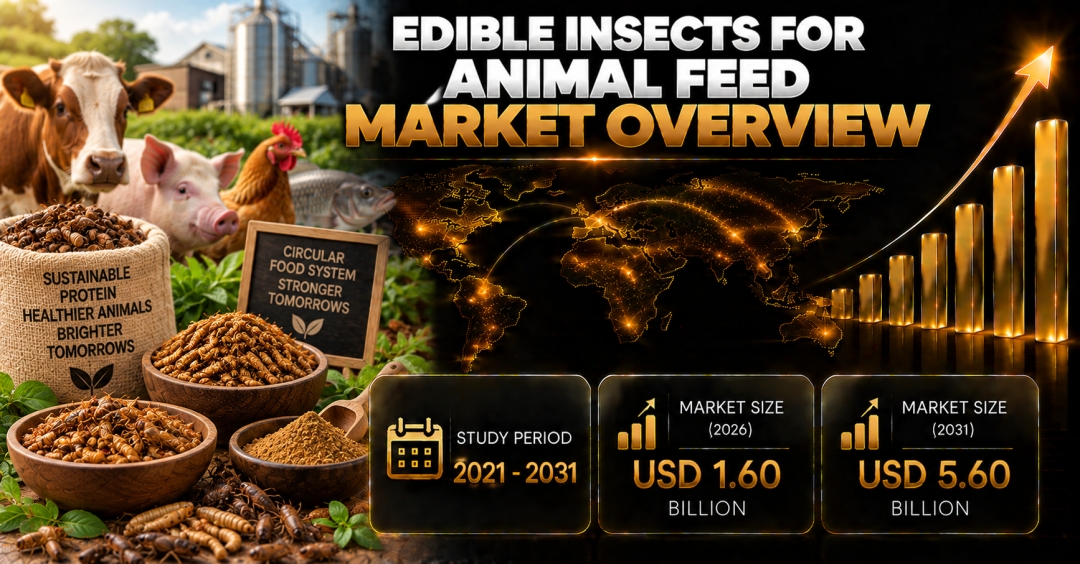
Hyderabad, September 22, 2026: According to Mordor Intelligence, the edible insects for animal feed market size is estimated to grow from $1.60 billion in 2026 to reach $5.60 billion by 2031, registering a CAGR of 13.47% during the forecast period (2026-2031). The market continues to expand as commercial feed compounders, livestock producers, and aquaculture operators prioritize sustainable, circular protein sources that alleviate pressure on traditional marine resources and arable land. Growing concerns over wild fish depletion, volatile soy prices, and the environmental impact of conventional feed ingredients continue to support demand across aquafeed, pet food, and livestock channels worldwide.
The edible insects for animal feed market is also being shaped by expanding regulatory approvals and evolving agricultural policies on circular bio-economy practices and carbon-reduction targets. Industrial insect rearing companies are investing in climate-controlled vertical breeding facilities and automated substrate management systems. These developments help businesses meet stricter environmental regulations and sustainability standards while maintaining nutritional density, amino acid completeness, and competitive unit pricing. Together, these factors continue to strengthen the integrated edible insects for animal feed market forecast across developed and emerging farming markets.
Edible Insects for Animal Feed Market Trends
Scaling of Automated Vertical Farming Optimizes Production Economics
One of the leading edible insects for animal feed market trends is the industrialization of breeding through high-density vertical rearing technologies. Production facilities increasingly utilize artificial intelligence, automated feeding conveyors, and precision optical sorting to monitor larval development in controlled environments. These operational upgrades maximize yield per square meter while drastically lowering thermal energy requirements and labor overheads. The resulting operational efficiencies reduce production costs per ton, supporting the edible insects for animal feed industry.
Black Soldier Fly Larvae Lead Production Volume and Processing Versatility
While mealworms and crickets maintain niche applications in companion animal nutrition, Black Soldier Fly (BSF) larvae account for the predominant share within the edible insects for animal feed market share. BSF larvae convert low-value organic side streams, brewery spent grains, and agricultural residues into high-protein biomass with remarkable feed conversion ratios. Compound feed manufacturers favor defatted BSF meal for its balanced crude protein profile and antimicrobial peptide content, which supports gut health in monogastric livestock and aquaculture species without synthetic additives.
Aquafeed and Premium Pet Food Drive Commercial Formulation Adoption
Application diversification remains an essential area of development across the edible insects for animal feed market growth. The aquaculture sector represents the largest commercial volume driver, utilizing insect protein meal as a natural, hypoallergenic replacement for marine fishmeal in carnivorous finfish and shrimp diets. Concurrently, premium pet food brands are rapidly integrating insect meals and purified insect oils into specialty formulations marketed to eco-conscious pet owners seeking novel, low-carbon proteins. This multi-species commercial adoption reinforces sustained category growth across feed compounders.
Lipid Extraction Unlocks High-Value Functional Feed Niches
Downstream processing technologies continue to play a significant role in market expansion. Modern biorefinery operations separate harvested larvae into protein meal, purified lipids, and nutrient-rich frass fertilizer. Extracted insect oils, rich in medium-chain fatty acids like lauric acid, are securing strong commercial demand as functional energy supplements for young animal diets and weaning piglets. These valorization pathways maximize total biomass value while providing organic certified soil amendments for commercial horticulture.
Europe Leads Regulatory Clearances While Asia-Pacific Expands Local Farming
Regional dynamics continue to influence the edible insects for animal feed market forecast. Europe commands a leading position in industrial-scale processing, supported by clear European Union regulatory approvals permitting insect proteins in aquaculture, poultry, and swine feed. Meanwhile, the Asia-Pacific region represents the fastest-growing market, bolstered by long-standing traditions of insect utilization, favorable tropical rearing climates, and expanding investments in commercial aquaculture feed production across Southeast Asia. Developing localized production models continues to create new opportunities for producers expanding their international footprint.
Check out more details and stay updated with the latest industry trends, including the Japanese version for localized insights: https://www.mordorintelligence.com/ja/industry-reports/global-edible-insects-for-animal-feed-market?utm_source=abnewswire
Edible Insects for Animal Feed Market Segmentation
By Insect Species
- Black Soldier Fly
- Mealworms
- Crickets
- Others
By Form
- Whole Dried
- Powdered Meal
- Oil
- Others
By Application
- Aquafeed
- Pet Food
- Poultry Feed
- Swine Feed
- Others
By Geography
- North America
- Europe
- Asia-Pacific
- South America
- Middle East and Africa
Competitive Landscape of the Edible Insects for Animal Feed Industry
The edible insects for animal feed industry exhibits a moderately consolidated structure, with specialized biotechnology pioneers, global agribusiness corporations, and industrial insect processors competing across production scale, feed safety certifications, and off-take supply agreements. Leading market participants are strengthening their market presence by constructing mega-scale automated biorefineries, co-locating facilities next to agricultural processing plants, and securing long-term supply arrangements with commercial feed manufacturers.
Substrate consistency and bioreactor automation continue to be critical areas of differentiation as producers invest in proprietary breeding genetics and robotic harvest systems to maintain uniform nutrient composition. Businesses are also refining distribution partnerships with multinational aquafeed corporations and animal nutrition compounders to guarantee multi-year purchase volumes. These initiatives are helping companies protect their edible insects for animal feed market share while maintaining quality consistency across global distribution networks.
Regional expansion also remains an important business strategy. Leading insect producers continue to establish production joint ventures near abundant agricultural waste sources, secure regional feed registrations, and leverage carbon credit platforms to lower net production costs. As commercial demand for sustainable, resilient feed ingredients continues to rise, the edible insects for animal feed market forecast remains supported by ongoing investments in bioconversion engineering, genomic selection, and worldwide operational scaling.
Key Players
Major companies operating in the edible insects for animal feed market include:
- Ynsect SAS
- Innovafeed SAS
- Protix B.V.
- Darling Ingredients Inc (EnviroFlight)
- Entobel Holding PTE. LTD
Conclusion
The edible insects for animal feed market forecast remains positive as feed compounders, livestock farmers, and aquaculture operations worldwide continue adopting circular, low-carbon protein sources that ease reliance on volatile traditional commodities. Insect biotechnology companies and ingredient processors are responding by expanding automated vertical farming modules, improving lipid refining lines, and developing specialized insect meals that balance protein performance with animal digestive health. These developments are expected to support continued demand across multiple commercial livestock and companion animal sectors.
Strategic regulatory alignment and circular supply integration are becoming increasingly vital as companies adapt to tightening environmental policies and feed safety standards. At the same time, specialized oil fractionation and co-location with agricultural side-stream sources are helping businesses enhance overall cost efficiency while supporting sustainable farming goals. These structural developments continue to guide modern edible insects for animal feed market trends.
Regional opportunities also remain strong. Europe provides a robust, highly regulated commercial baseline, while Asia-Pacific and the Americas offer attractive growth pathways as regional aquaculture development and commercial feed investments accelerate daily protein demand. This shift is expected to create new commercial avenues for insect protein manufacturers expanding their operational footprint in developing markets.
Overall, the edible insects for animal feed market size is expected to benefit from changing livestock nutrition paradigms, growing demand for regenerative protein sources, wider availability across industrial feed mills, and an ongoing commitment to bioprocessing efficiency. Together, these factors are expected to support sustained edible insects for animal feed market growth while strengthening the long-term outlook for the global edible insects for animal feed industry.
Industry-Related Reports
Feed Premix Market: The global feed premix market is projected to reach $32.29 billion by 2031, expanding at a 5.42% CAGR from its 2026 valuation of $24.79 billion and 2025 base of $23.52 billion. The transition from on-farm mixing to industrial compound feed systems across Asia, Africa, and South America is driving demand for traceable micronutrient packages, supported by broad livestock and aquaculture output gains.
Plasma Feed Market Size: The global plasma feed market is estimated at $3.21 billion in 2025 and is projected to reach $4.11 billion by 2030, growing at a 5.07% CAGR. Growth is driven by the industry-wide transition toward antibiotic-free livestock production and rising demand for highly digestible, immunoglobulin-rich proteins in swine weaning and pet food formulations. North America and Asia-Pacific anchor consumption.
Feed Enzymes Market Share: The global feed enzymes market is expected to expand from $1.52 billion in 2026 to $1.94 billion by 2031, registering a 5.06% CAGR from its 2025 valuation of $1.45 billion. Stricter curbs on antimicrobial growth promoters and grain price volatility are driving feed mills to deploy high-efficiency phytases and carbohydrases to optimize nutrient bioavailability and feed conversion efficiency.
About Mordor Intelligence:
Mordor Intelligence is a trusted partner for businesses seeking comprehensive and actionable market intelligence. Our global reach, expert team, and tailored solutions empower organizations and individuals to make informed decisions, navigate complex markets, and achieve their strategic goals. With a team of over 550 domain experts and on-the-ground specialists spanning 150+ countries, Mordor Intelligence possesses a unique understanding of the global business landscape. This expertise translates into comprehensive syndicated and custom research reports covering a wide spectrum of industries, including aerospace & defense, agriculture, animal nutrition and wellness, automation, automotive, chemicals & materials, consumer goods & services, electronics, energy & power, financial services, food & beverages, healthcare, hospitality & tourism, information & communications technology, investment opportunities, and logistics.
Media Contact
Company Name: Mordor Intelligence
Contact Person: Jignesh Thakkar
Email: Send Email
Phone: +1 617-765-2493
Address:11th Floor, Rajapushpa Summit, Nanakramguda Rd, Financial District, Gachibowli [email protected]
City: Hyderabad
State: Telangana 500008
Country: India
Website: https://www.mordorintelligence.com/industry-reports/global-edible-insects-for-animal-feed-market?utm_source=abnewswire

