
Seavoice Launches Multilingual AI Voice Agent with Mid-Call Code-Switching for Enterprise Contact Centers in Southeast Asia
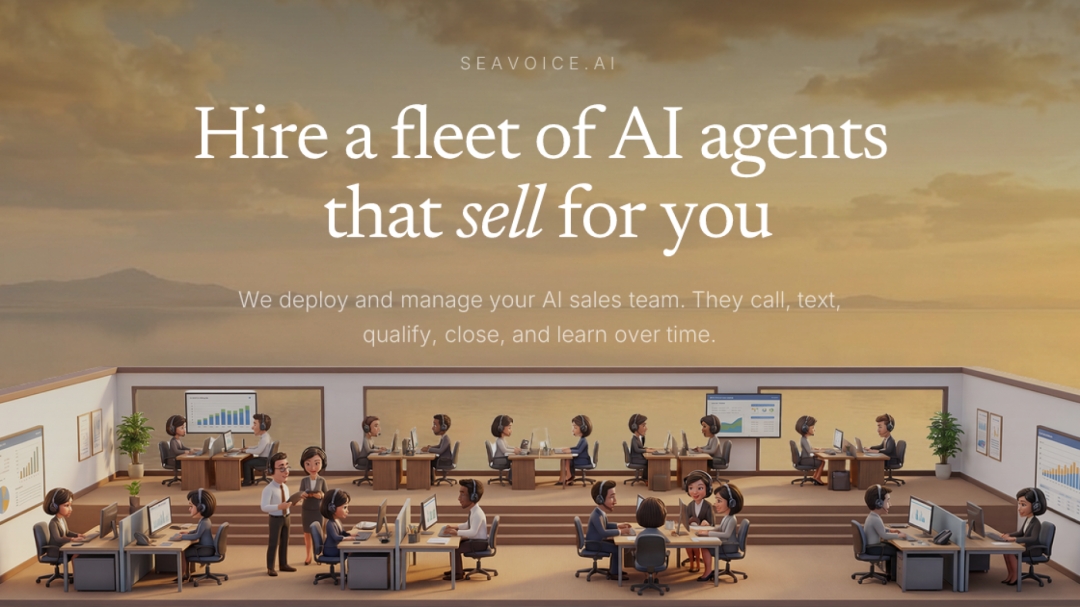
Malaysia – August 21, 2026 – Seavoice, a managed AI voice agent platform for enterprise contact centers, has launched a multi-lingual voice AI agent purpose-built for Southeast Asian enterprises. The company says the agent supports more than 15 languages and, critically, switches mid-call between English, Bahasa Malaysia, Mandarin, Tamil, and localized dialects such as Singlish and Manglish — a capability called code-switching.
For enterprises across Singapore, Malaysia, and the wider region, Seavoice positions this as the answer to a specific and persistent gap: global voice-AI platforms rarely handle the way Southeast Asian customers actually talk, and customers are quick to disqualify any agent that sounds like “a more English person on the phone.”
“Customers in Southeast Asia don’t stay in one language on a call. They start in English, drift into Bahasa or Mandarin mid-sentence, then back again,” said Kai Song, founder of Seavoice. “Most voice AI agents freeze or mishear the moment a customer code-switches. Ours follows them — the call keeps flowing, and the conversation doesn’t drop.”
Crucially, Seavoice is not positioning the agent purely as a support tool. While the agent handles inbound service and qualification, the company’s stated aim is to turn ordinary customer interactions into revenue opportunities — upselling on top of support, releasing agents to answer questions about pricing and offers, and converting more of the conversations that a contact center already has.
Why it matters now
Southeast Asia’s contact centers face a structural squeeze. Agent turnover runs well above the rate of other roles, staffing must flex with spiky demand, and enterprise hiring is slow — banks and telcos cannot simply add and shed headcount to chase a seasonal campaign. At the same time, regulated industries operate under data-residency and privacy obligations that many global voice-AI vendors cannot easily meet.
The seasonality is real, the company notes. In a telco market structured as an oligopoly, a competitor’s switch campaign forces a defensive sales push within weeks; in enterprise finance, the final quarter of a financial year drives a spike of activity that nobody wants to staff permanently.
“Enterprise buyers here don’t just want a platform. They want to know the agent sounds local, that it can go live quickly, and that they can scale it up for a three-month campaign and back down again — without hiring or firing anyone,” Kai Song said.
What was launched
Seavoice’s voice AI agent is delivered through a managed engagement, not a self-serve builder. Customers brief Seavoice on scripts, objection handling, and offers; the company then configures and deploys the agent — alongside a supporting set of internal agents for building, analysis, and knowledge — under a dedicated account manager. The result, the company says, is an agent that can go live in days rather than the multi-month transformation that scares enterprise buyers.
To de-risk adoption, Seavoice runs a structured pilot: a single use case in the first week, a four-week proof with a measured volume of calls, and a business ROI report designed to make the internal business case straightforward.
The agent also extends beyond a single call. Seavoice says its agents handle long-horizon task sequences — following up after a call, escalating to the right team, confirming back to the customer — rather than ending the interaction when the first ticket closes.
How enterprises use it
Across industries, Seavoice says the same agent spans a spectrum of use cases, from revenue generation to service recovery:
- Telcos run recontracting and upsell campaigns — renewing subscriptions and upgrading plans on a defensive or offensive basis as competitors launch switch offers — as well as inbound sales for new sign-ups and plan changes.
- Banks and financial institutions use the agent for outbound telemarketing — credit-card, personal-loan, insurance, and investment-product offers — and for service-to-sales, where an inbound request such as “activate my travel plan” becomes a natural opportunity to offer travel insurance.
- Fintech and consumer finance companies deploy lead qualification — for example, calling a customer who clicked an ad to book a test drive or complete an application — a step buyers often don’t categorize as “sales,” but which sits squarely inside Seavoice’s reach.
- Healthcare and hospital groups rely on inbound appointment booking and triage, gathering availability and scheduling requests around the clock, including the follow-up calls that tie a central help desk to specialist clinics.
- Hospitality, travel, and education capture 24/7 inbound bookings and enrollment during seasonal spikes, when a human team cannot scale up quickly enough.
Because the agent is managed and can scale up or down on demand, the company notes that these use cases flex with each organization’s calendar — a telco reacting to a competitor’s switch campaign, or a bank pushing harder in the final quarter of its financial year — without the overhead of hiring or firing.
Key capabilities
- 15+ languages with mid-call code-switching — the agent holds a conversation across English, Bahasa Malaysia, Mandarin, Tamil, and local dialects including Singlish and Manglish, without dropping context when the customer shifts language mid-sentence.
- Natural, localized voice — built to sound like a local speaker rather than a generic English agent, addressing the most common first-round disqualifier for enterprise buyers.
- Service-to-sales — inbound service and qualification that surfaces revenue opportunities such as upsells and renewals, positioning the agent as a growth driver rather than a cost-containment tool.
- Long-horizon task sequences — multi-step follow-ups, escalations, and confirmations that continue beyond the first call.
- Managed go-live in days — configured and deployed under a dedicated account manager, with a structured four-week pilot and measured ROI.
- 24/7 operations with instant scale — up or down on demand to match campaign and seasonal spikes, with no hiring cycle.
- Enterprise posture — data residency across Malaysia, Singapore, and the US, with SOC 2 compliance and a standing policy of no training on customer data.
Availability
Seavoice’s multi-lingual AI voice agent is available now to enterprise customers in Southeast Asia. Deployment is managed, begins with a structured pilot, and goes live in days.
About Seavoice
Seavoice is a managed AI voice agent platform for enterprise contact centers. It deploys and operates voice AI agents that call, answer, qualify, follow up, and learn over time — with a focus on turning customer interactions into revenue opportunities rather than pure cost-containment. Seavoice serves banks, telcos, and large consumer brands across Southeast Asia with agents that switch mid-call across 15+ languages and local dialects, hold natural localized conversations, and operate 24/7. Deployment is managed, enterprise-grade, and outcome-oriented.
For more information, visit Seavoice.
Media Contact
Company Name: Seavoice
Contact Person: Kai Song Eer
Email: Send Email
Phone: +60 11-0000 0000
Country: Malaysia
Website: https://seavoice.ai/

